Launch offer — valid today only

📄 Digital book in PDF · read it on your phone or print it

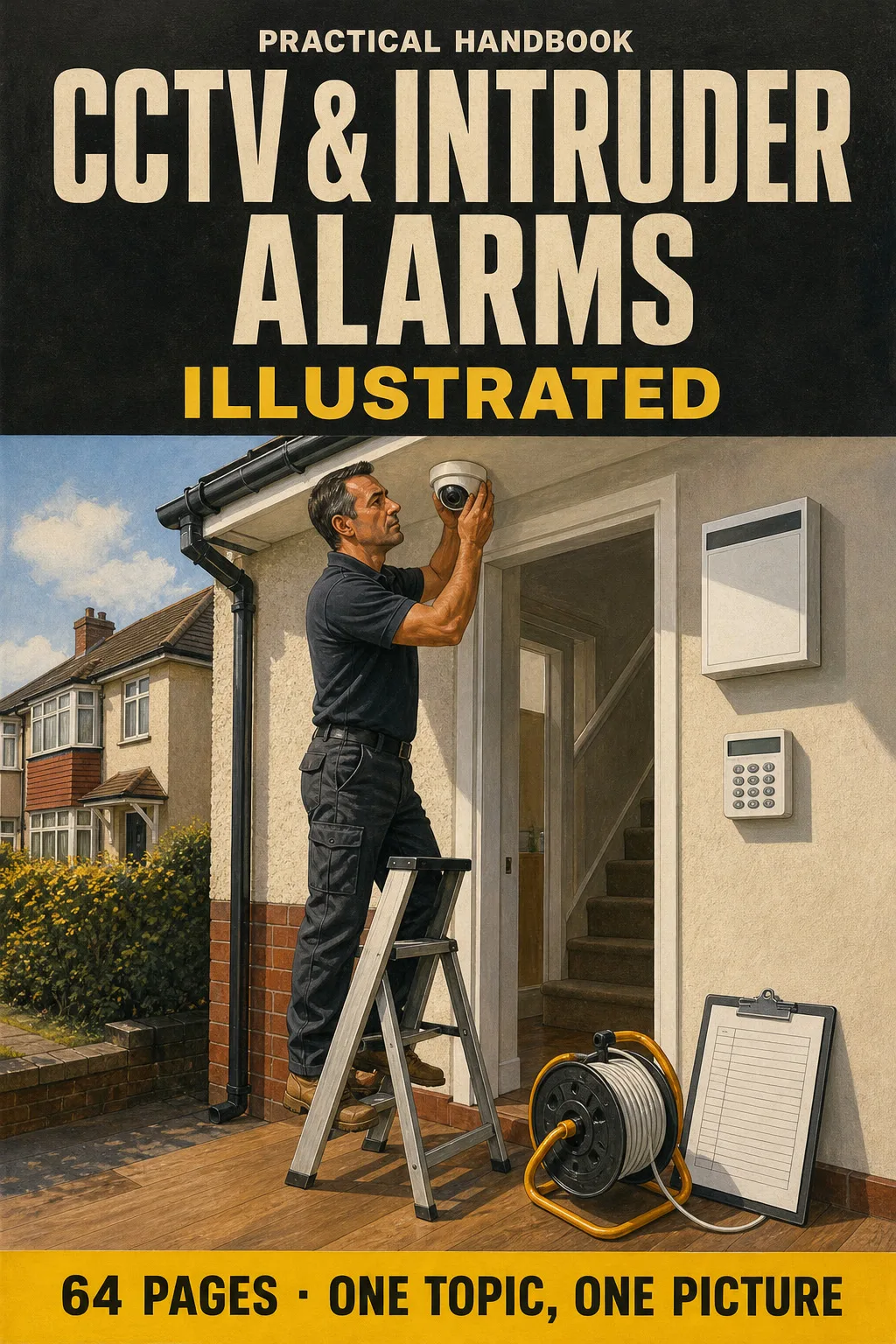
Intruder Alarms and CCTV for UK Installers, in Drawings The Same Steps on Every Job

Alarm panels, security grades, PIR siting, zones, alarm cable, camera lenses and heights, PoE, recording days and fault finding. Every topic has its own page: the drawing first, then what you need to remember. 64 illustrated pages.

GET THE 64 ILLUSTRATED PAGES

🔒 Secure checkout · PDF by email · 30-day guarantee

Every topic, its own pageEach system and each task drawn, with the explanation alongside
64 illustrated pages8 parts, from the intruder alarm drawn end to end to the whole job on one page
Up-to-date sourcesBS EN 50131, BS EN 62676-4 and BS 7671
PDF by emailFormat

Look Inside the Book

Every page has one large drawing and a box with the numbers and steps you need to know:

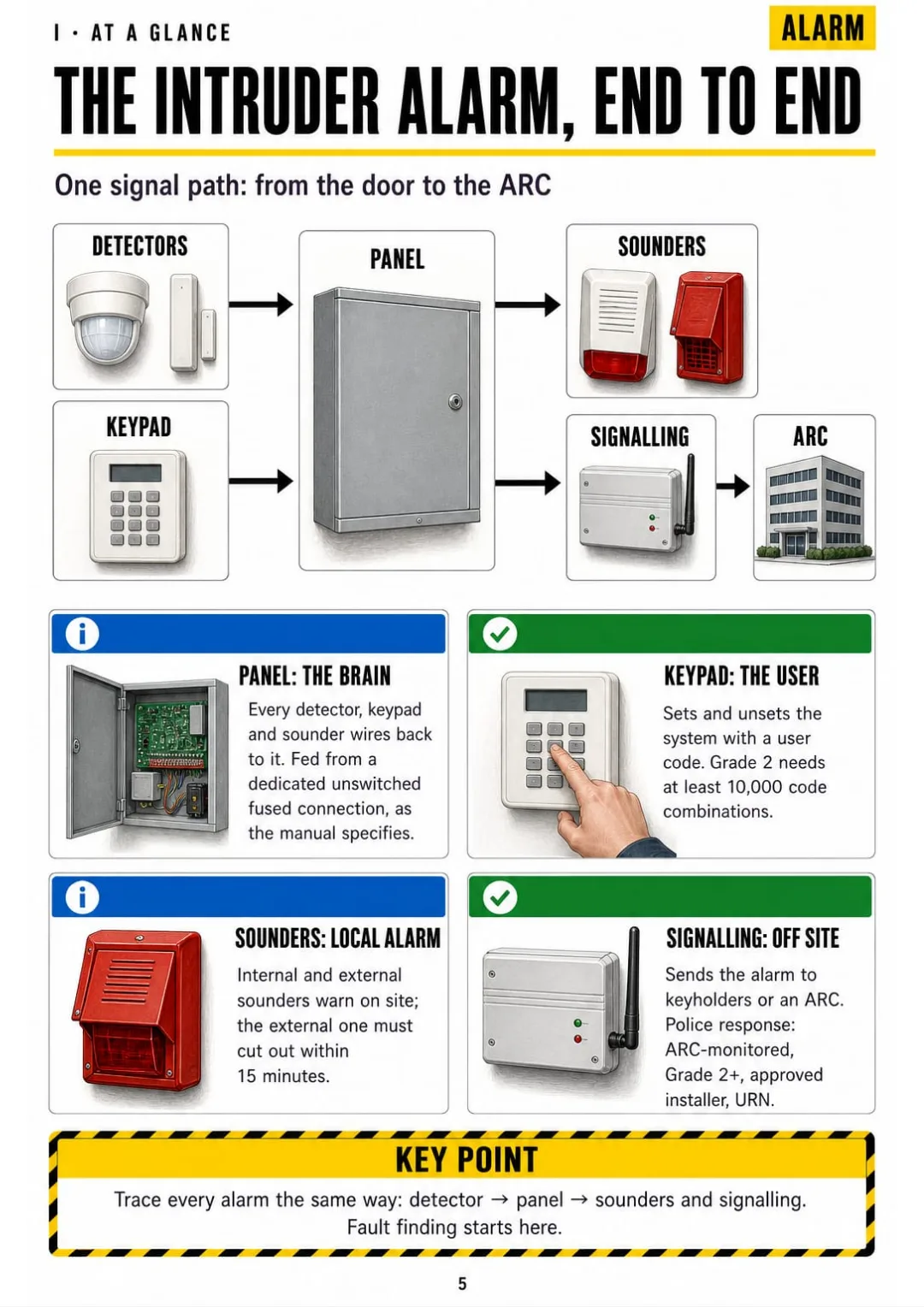
Detector → panel → sounders and signalling: the whole intruder alarm in one drawing
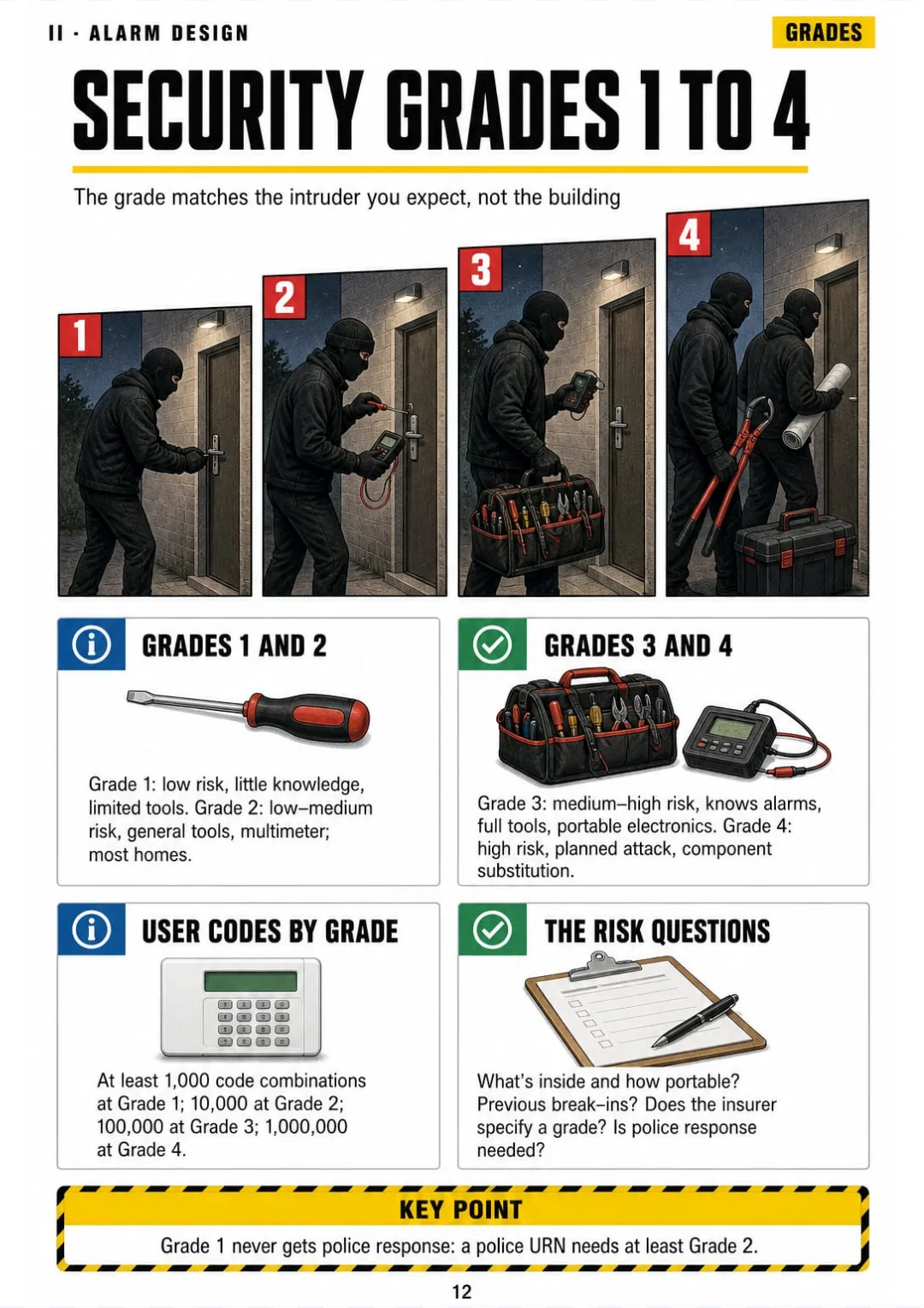
Grades 1 to 4 drawn as four intruders, from bare hands to a planned attack
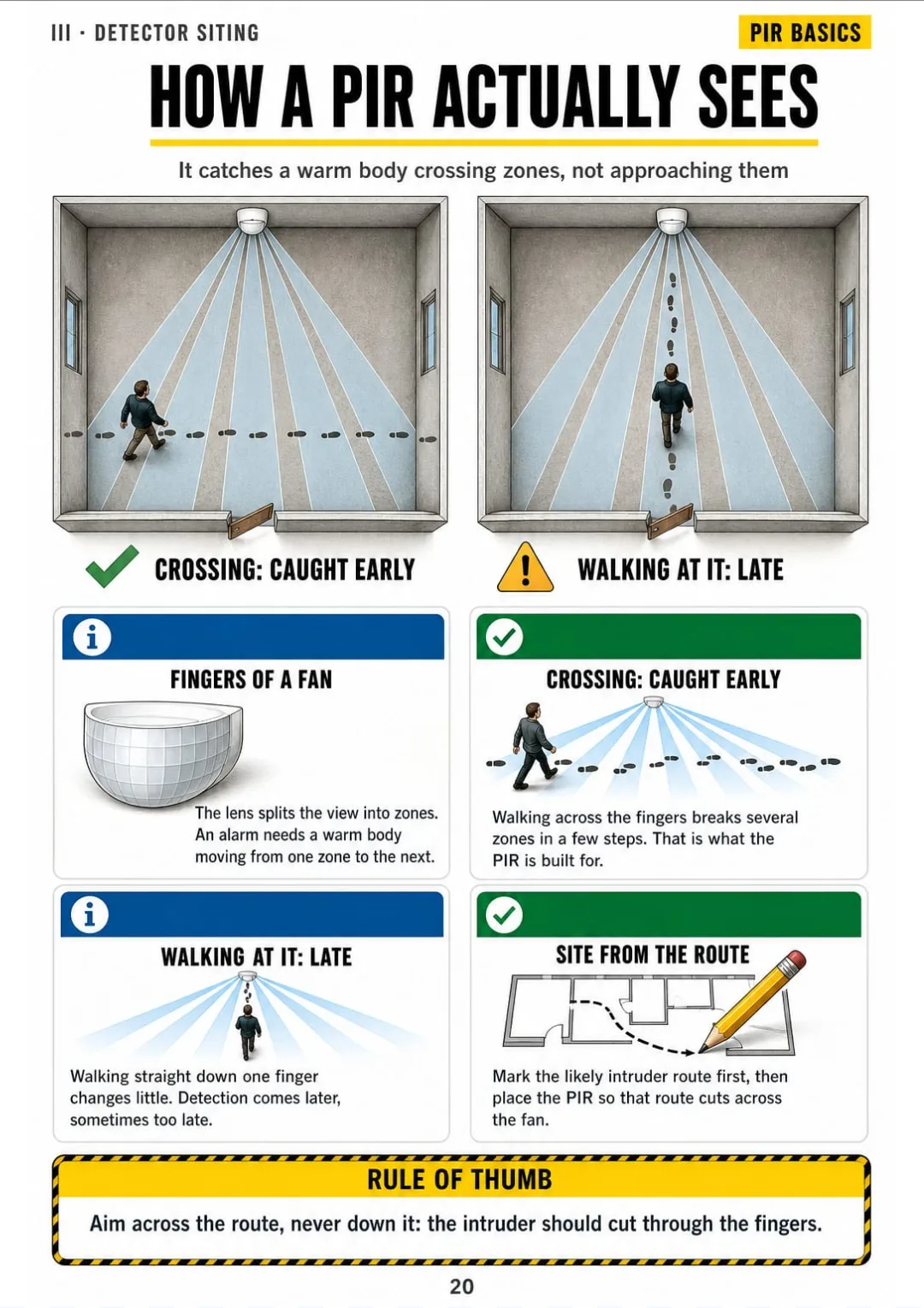
Crossing the detection fingers triggers a PIR far sooner than walking straight towards it.
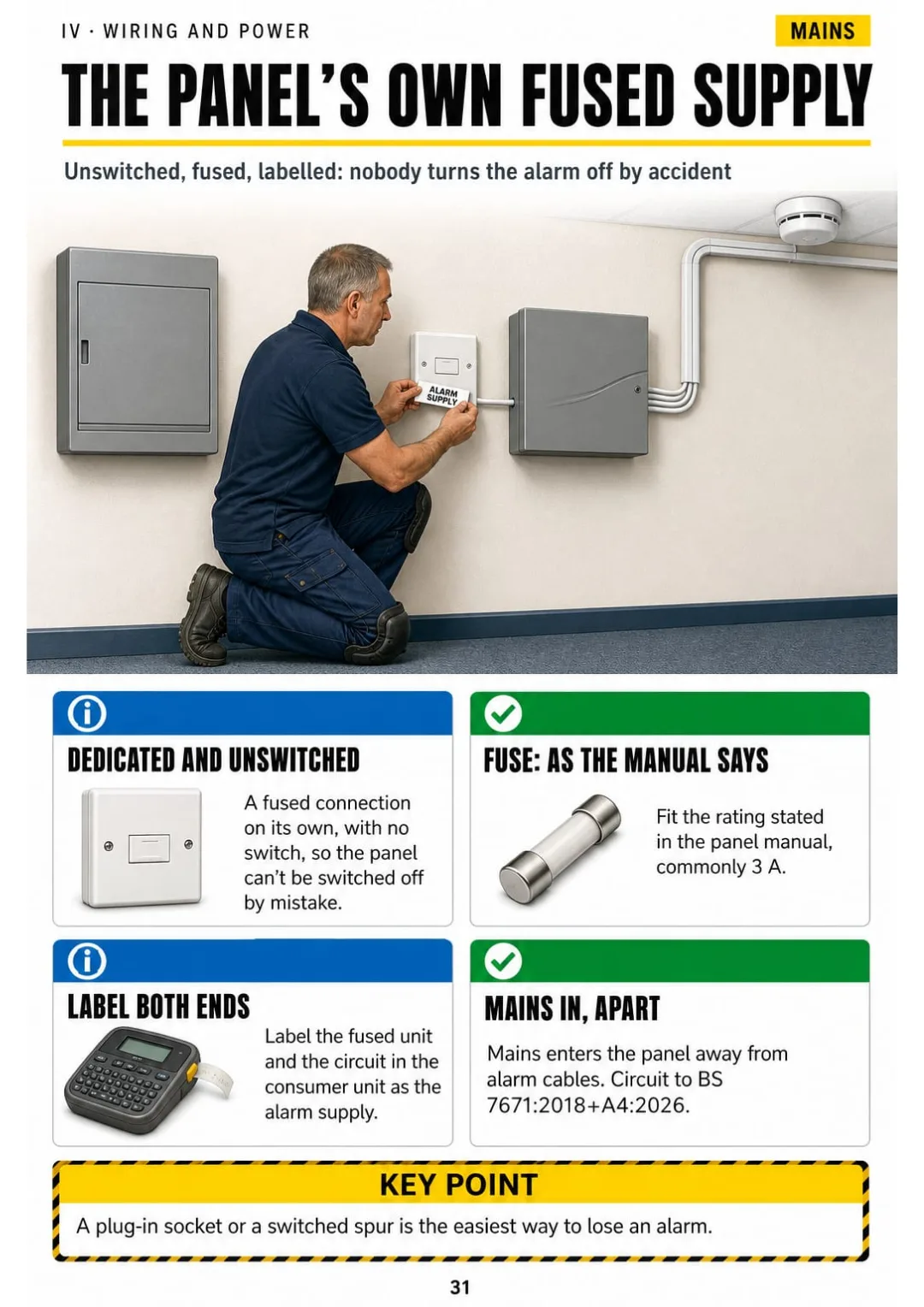
Dedicated, unswitched, fused as the panel manual says (commonly 3 A) and clearly labelled.
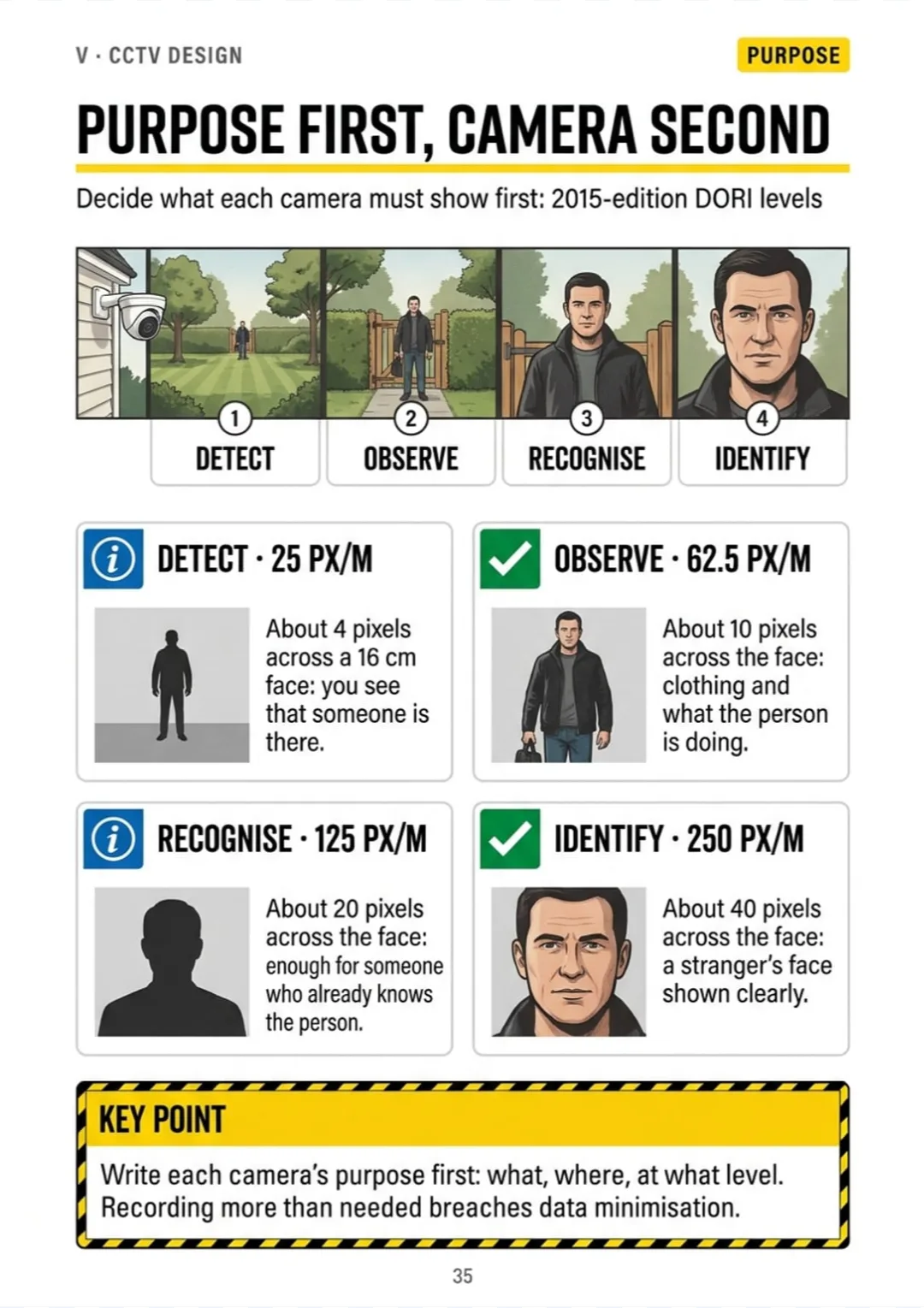
Detect, observe, recognise, identify: 25, 62.5, 125 and 250 px/m, drawn at the same gate.
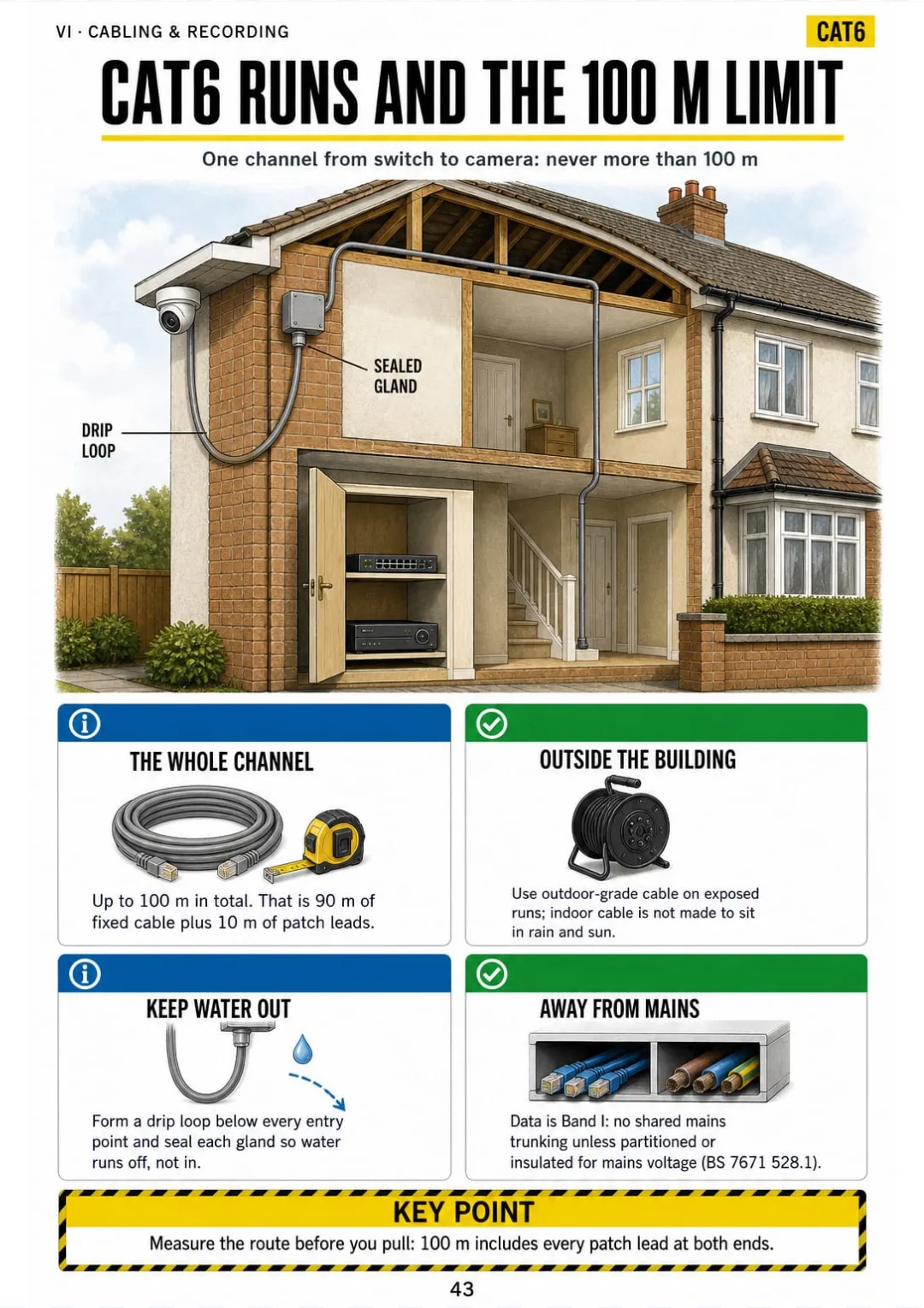
Ethernet channel: 90 m fixed cable + 10 m patch leads = 100 m maximum
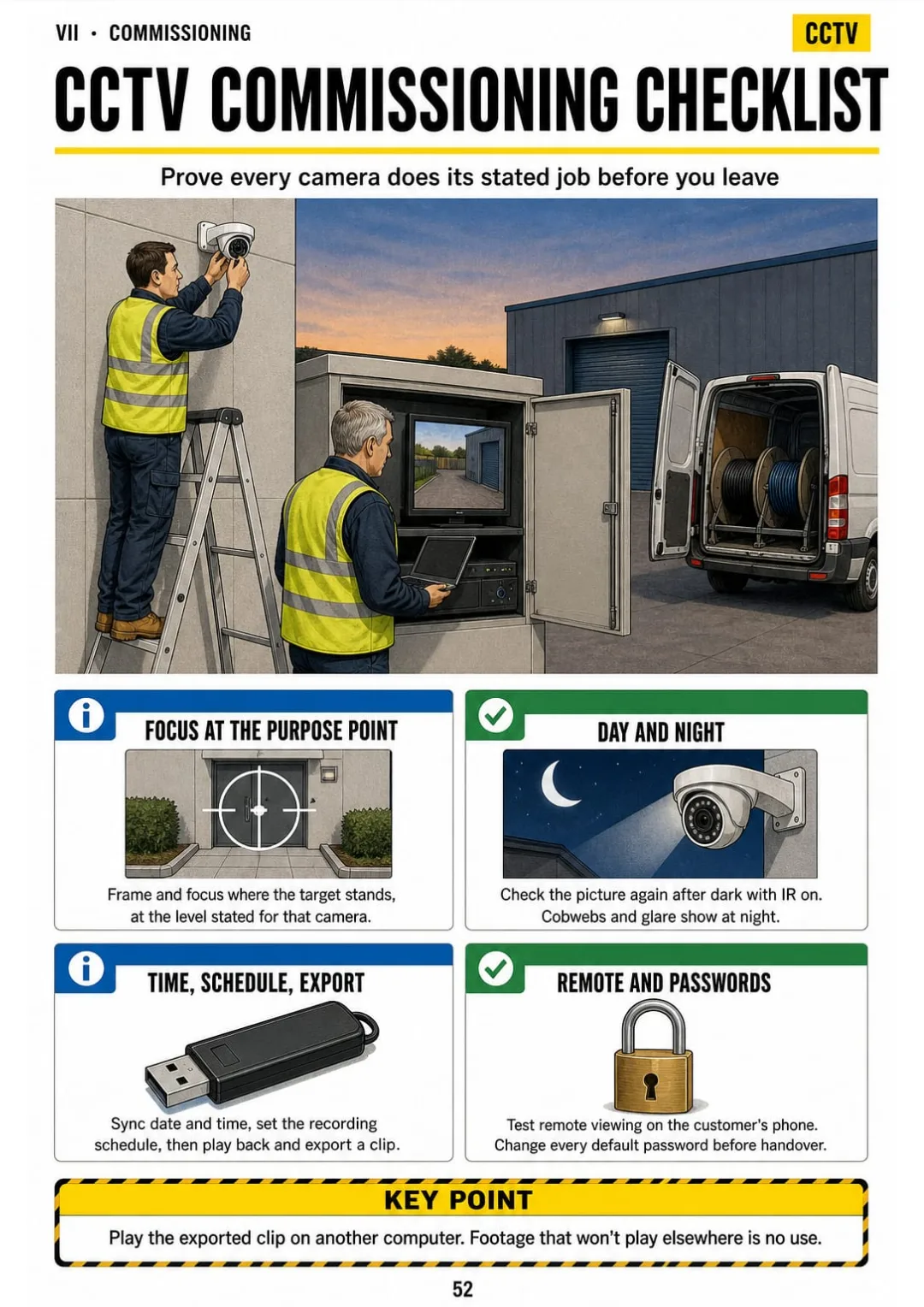
CCTV commissioning: focus at the purpose point, night check, time sync, export test, passwords changed.
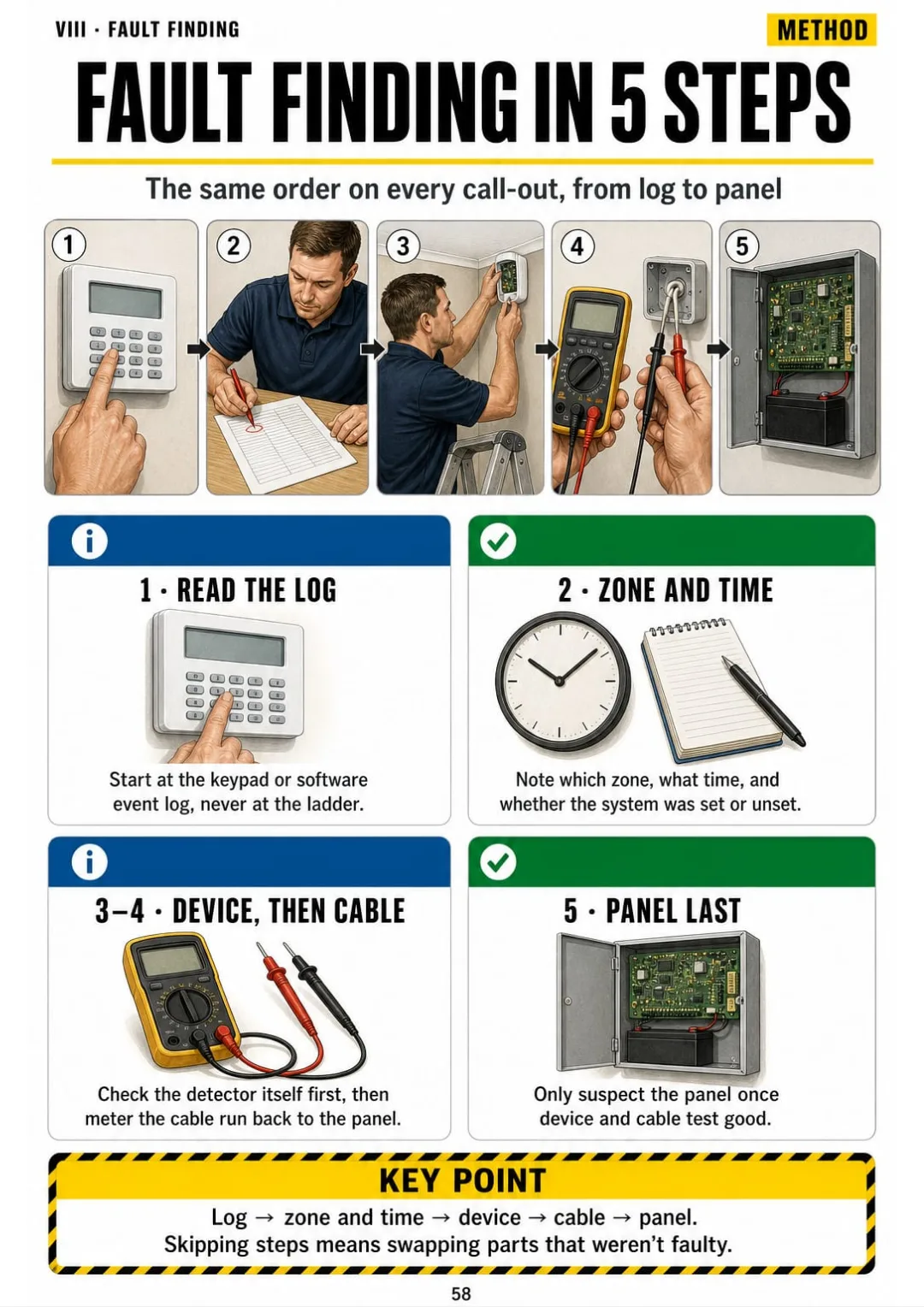
Log, zone, device, cable, panel: one fault-finding order for every call-out.

Swipe to see more →

These are real pages from the book. The table of contents is the full one: 8 parts and 60 topics.

The Problem Isn't You. It's How It Was Explained to You.

You're in a customer's living room with a PIR in your hand. They want to know if it will catch someone coming in through the patio door, and you have to pick the corner now.

The detector leaflet covers it in paragraphs: coverage pattern, zones, sensitivity, pulse count. Nothing on the page shows you which way an intruder actually walks.

Crossing the detection fingers triggers a PIR far sooner than walking straight towards it.

In the book, the PIR is a drawing. The detection fingers fan out from the corner and two people walk through the room. The one crossing the fingers trips it far sooner than the one walking straight at it. So you aim it across the route, not down it.

Security grades 1 to 4, end-of-line resistors, camera height and pixel density, the 100 m Cat6 limit, the fault-finding order: each one has its own page, drawn the same way.

You look, you see why, and you fit it without going back to the leaflet. Right first time, with the customer watching.

COMPARE FOR YOURSELF

The Same Topic, Two Ways to Learn It

THIS
  • The manual: line after line
  • Security grades explained only in words
  • You get to site still unsure
Choosing the grade of an intruder alarm means looking at the premises, what is kept there, how likely a break-in is and what the insurer asks for. Each grade then brings its own requirements for detectors, tamper protection, signalling and power supplies, and the differences between neighbouring grades are spread across several sections, each with its own exceptions and cross-references to other documents.
FOR THIS
  • Each security grade in one drawing
  • The key numbers in one box
  • You look, and it makes sense
Grades 1 to 4 drawn as four intruders, from bare hands to a planned attack
CONTENTS

Take a Look at the 8 Parts and 60 Topics

The system at a glance, intruder alarm design, detector siting, alarm wiring and power, CCTV design, cabling, PoE and recording, commissioning and handover, and fault finding: 64 pages, all illustrated.

IThe System at a Glance · pp. 5-11
  1. The intruder alarm drawn end to end
  2. The CCTV system drawn end to end
  3. Wired, wire-free or hybrid
  4. The UK rulebook in one page
  5. Your job in 7 steps, every time
  6. The site survey: what to look at before quoting
  7. Words that get mixed up on site
IIIntruder Alarm Design · pp. 12-19
  1. Security grades 1 to 4
  2. Environmental classes I to IV
  3. Choosing the grade: three worked examples
  4. Zone types and what they do
  5. Building a zone schedule
  6. Areas, part-set and night set
  7. Entry and exit routes and timers
  8. Signalling: bells-only vs monitored
IIIDetector Siting · pp. 20-27
  1. How a PIR actually sees
  2. PIR mounting height and coverage
  3. What causes PIR false alarms
  4. Dual technology detectors
  5. Pets and pet-tolerant detectors
  6. Door contacts and shock sensors
  7. Anti-masking and grade 3 detectors
  8. Siting a full house on a floor plan
IVAlarm Wiring and Power · pp. 28-34
  1. Alarm cable: cores and colours
  2. End-of-line resistors (EOL)
  3. The tamper circuit
  4. Mains supply to the panel
  5. Standby batteries and the current sum
  6. Voltage drop on long detector runs
  7. Sounders: internal, external and cut-off
VCCTV Design · pp. 35-42
  1. Start with the purpose of each camera
  2. Pixel density: why no one's face shows
  3. Focal length and field of view
  4. Camera height and angle
  5. Light: IR, backlight and WDR
  6. Bullet, turret, dome and PTZ
  7. Placing cameras on a site plan
  8. Privacy: where the camera must not look
VICCTV Cabling, PoE and Recording · pp. 43-49
  1. Cat6 runs and the 100 m limit
  2. Terminating RJ45 the same way every time
  3. PoE power budget
  4. NVR vs switch: where cameras plug in
  5. Recording days: the storage sum
  6. H.264, H.265 and motion recording
  7. Coax and analogue upgrades
VIICommissioning, Handover and Maintenance · pp. 50-57
  1. Alarm commissioning checklist, in order
  2. The walk test done properly
  3. CCTV commissioning checklist
  4. Confirmed alarms and police response
  5. Handover: what the customer must know
  6. Paperwork to leave on site
  7. CCTV signs and the customer's duties
  8. Planned maintenance visits
VIIIFault Finding and Final Review · pp. 58-64
  1. Fault finding in 5 steps
  2. The 3 a.m. false alarm
  3. Tamper and zone faults
  4. Battery and power faults
  5. No picture, no recording
  6. Most frequent installation mistakes
  7. The whole job on one page

One Page, One Topic, All Clear

Think of it this way:

A customer wants a camera on the drive that shows who is at the gate, not just that someone was there. The ladder is up and you need to choose the lens and the height now.

You open the camera-purpose page first: detect, observe, recognise and identify drawn at the same gate, with 25, 62.5, 125 and 250 px/m. You pick the purpose, and the lens follows.

Detect, observe, recognise, identify: 25, 62.5, 125 and 250 px/m, drawn at the same gate.

Same with security grades, PIR siting, end-of-line resistors, the PoE power budget and the recording-days sum: each one on its own page.

CCTV & Intruder Alarms Illustrated is 64 illustrated pages in 8 parts, and it ends with the most frequent installation mistakes and the whole job on one page.

What you see drawn, you don't have to memorize.

What's Inside CCTV & Intruder Alarms Illustrated:

Ipp. 5-11

The System at a Glance

The intruder alarm and the CCTV system drawn end to end, wired vs wire-free, the UK rulebook on one page, your job in 7 steps, the site survey and the words that get mixed up on site.

IIpp. 12-19

Intruder Alarm Design

Security grades 1 to 4, environmental classes, three worked examples for choosing the grade, zone types, the zone schedule, part-set, entry and exit routes and signalling.

IIIpp. 20-27

Detector Siting

How a PIR really sees, mounting height, what causes false alarms, dual technology, pet-tolerant detectors, door contacts, anti-masking and a full house sited on a floor plan.

IVpp. 28-34

Alarm Wiring and Power

Alarm cable cores and colours, end-of-line resistors, the tamper circuit, the mains supply, standby batteries and the current sum, voltage drop and sounders.

Vpp. 35-42

CCTV Design

The purpose of each camera, pixel density, focal length, height and angle, IR and WDR, camera types, placing cameras on a site plan and where a camera must not look.

VIpp. 43-49

CCTV Cabling, PoE and Recording

Cat6 runs and the 100 m limit, RJ45 terminations, the PoE power budget, NVR vs switch, the storage sum for recording days, H.265 and coax upgrades.

VIIpp. 50-57

Commissioning, Handover and Maintenance

Alarm and CCTV commissioning checklists, the walk test, confirmed alarms and police response, handover, paperwork, CCTV signs and planned maintenance visits.

VIIIpp. 58-64

Fault Finding and Final Review

Fault finding in 5 steps, the 3 a.m. false alarm, tamper and zone faults, battery faults, no picture, the most frequent installation mistakes and the whole job on one page.

At the end of the book: A 7-step job routine, worked examples for grades, field of view and storage, and the whole job on one page.
Plus: 2 Free Books

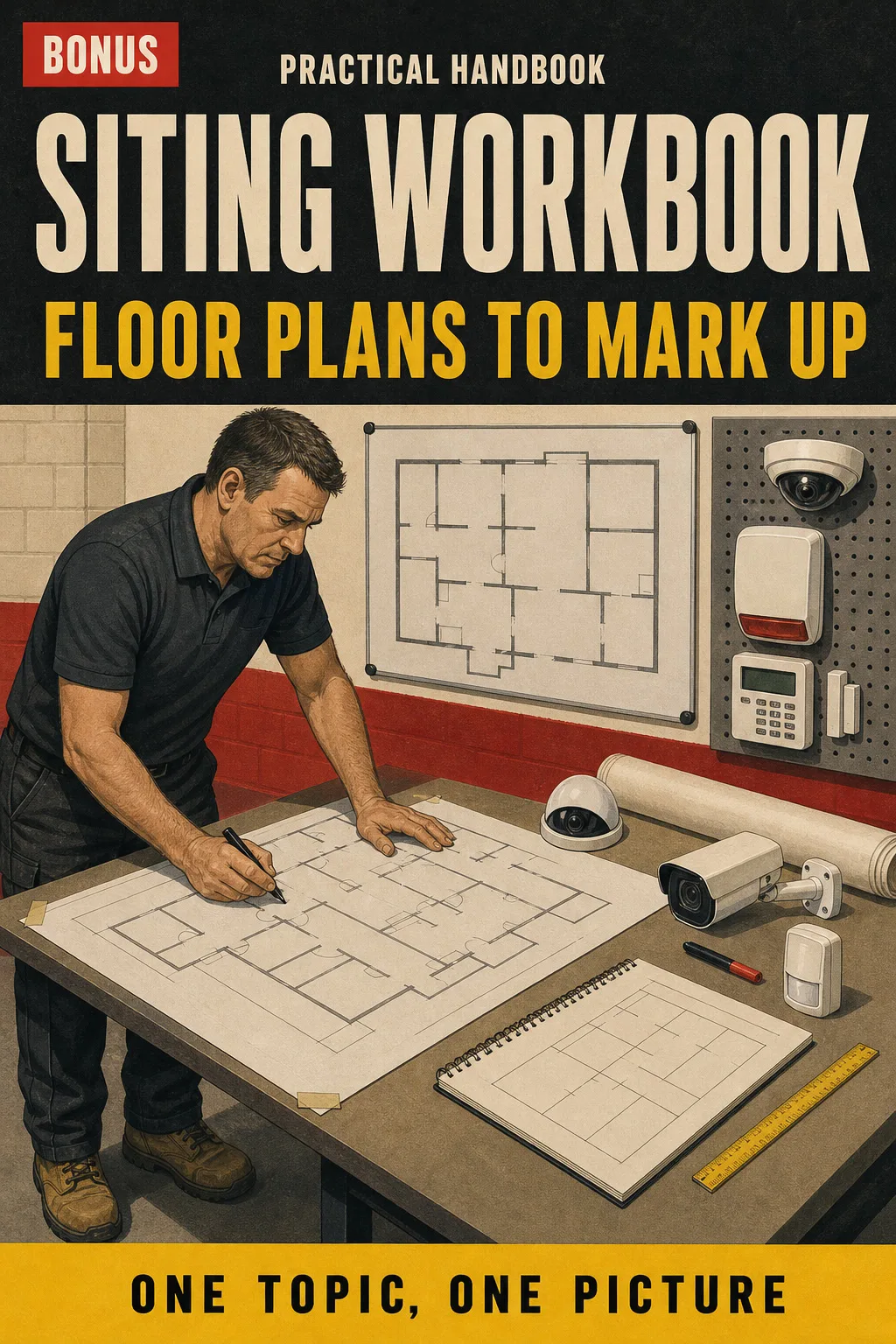
Siting Workbook: Floor Plans to Mark Up

BONUS 1: «Siting Workbook: Floor Plans to Mark Up»

Value on its own: US$ 17.90

Practise placing PIRs, door contacts and cameras on real-style floor plans, then check your choices against the drawn answers.

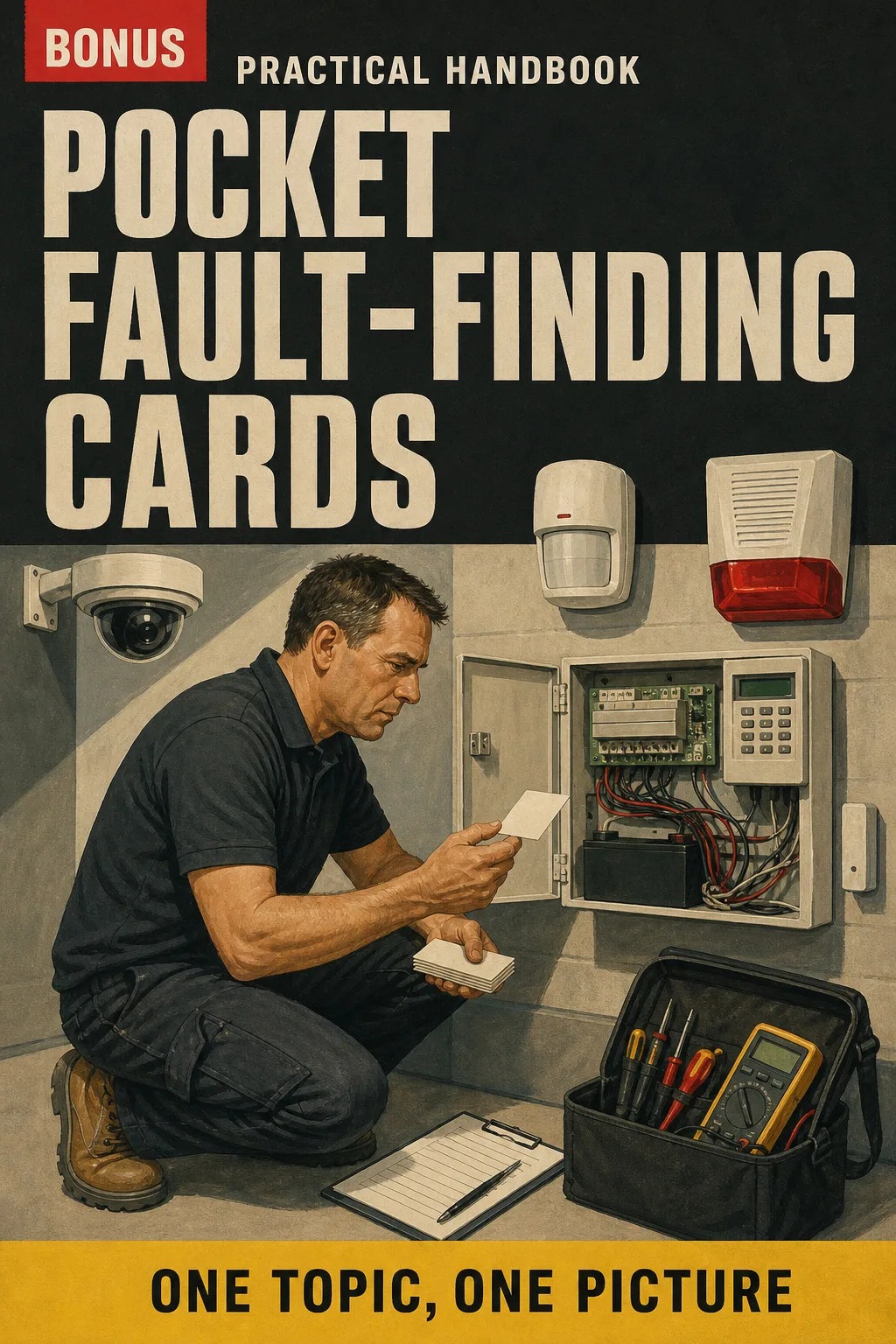
Pocket Fault-Finding Cards

BONUS 2: «Pocket Fault-Finding Cards»

Value on its own: US$ 14.90

One card per symptom (false alarm, tamper fault, no picture, recorder full) with the likely causes and the checks to do, in order, to keep in the van.

CCTV & Intruder Alarms Illustrated with 2 Free Books

  • CCTV & Intruder Alarms Illustrated: 64 illustrated pagesUS$ 63
  • BONUS 1: Siting Workbook: Floor Plans to Mark UpUS$ 17.90
  • BONUS 2: Pocket Fault-Finding CardsUS$ 14.90
  • High-resolution PDF to printIncluded
Total value US$ 95.80
YOUR PRICE:
US$ 27
You save US$ 68.80
YES, I WANT CCTV & INTRUDER ALARMS ILLUSTRATED FOR US$ 27

📄 This is a digital PDF book sent to your email: nothing is printed or shipped.

Secure purchaseEncrypted payment30-day guarantee

PDF by email: We email you CCTV & Intruder Alarms Illustrated as a PDF, together with the two free books. It's a single payment: no installments, no extra charges.

Who This Book Is For

You're adding alarms and CCTV to your electrical work

You're adding alarms and CCTV to your electrical work

The wiring you already know. The book shows you the rest drawn: where each detector goes, which grade to quote and which lens a camera needs.

You take the call-outs and service visits

You take the call-outs and service visits

Fault finding in 5 steps and the 3 a.m. false alarm on their own pages, so every call-out starts in the same order.

You run a small installation firm

The whole job drawn from survey to handover, so you and your new starter fit every site the same way.

Everything You Get Today

US$ 95.80US$ 27
YES, I WANT CCTV & INTRUDER ALARMS ILLUSTRATED FOR US$ 27

📄 This is a digital PDF book sent to your email: nothing is printed or shipped.

30DAYS
GUARANTEE

30-Day Guarantee

Try CCTV & Intruder Alarms Illustrated for 30 days, bonus books included.

We refund everything if the file won't open, if the book isn't what you see here, if you were charged twice or if the email doesn't arrive. Just email us.

You pay once. No subscriptions.

Frequently Asked Questions

Is it for me if I've been fitting alarms and cameras for years?

It isn't a beginner's book. It's the whole job drawn in order, from survey to fault finding, so you can check a grade, a cable length or a storage sum in seconds. It's written for UK work: British Standards, UK police response, metric units and the cable you fit here. Not an American book.

Where does the content come from?

It's written in line with current UK guidance: the BS EN 50131 series and PD 6662, BS 8243, police response policy on alarms, BS EN 62676-4, BS 7671 and the ICO's guidance on video surveillance. The data protection pages tell you what to explain to the customer; they aren't legal advice.

Is it official material?

No. It's an independent illustrated book. It isn't published or endorsed by any standards body, police body, regulator or manufacturer, and it doesn't give you a certificate or count towards any approval scheme.

Does it replace training or the manufacturer's instructions?

No. It sits alongside them. It doesn't walk through the menus of any one panel or NVR brand: programming, resistor values and product limits always follow the maker's manual for the kit you fit. What the book draws is the part that's the same on every brand: grades, siting, zones, cabling, commissioning and fault finding.

Are the practice exercises taken from an exam?

No. The floor plans and exercises are written for this book. They aren't questions from any exam or assessment.

When and how does it arrive?

The book and the 2 free books arrive as PDFs by email, to the address you enter at checkout.

Do I have to pay every month?

No. It's a one-off payment. No subscription.

Can I have it on paper?

It's a PDF, not a printed book, but it prints on standard A4, so you can keep a copy in the van.

How does the refund work?

You have 30 days. We refund everything if the file won't open, if the book isn't what you see on this page, if you were charged twice or if the email doesn't arrive: just email us.

Before You Close This Page

No more rereading a leaflet that doesn't stick.

Where the PIR goes, you see it drawn, and that's it.

You get to every job knowing where everything is.

Drawings make studying faster.

The book is right below.

One-time payment: US$ 27 · Guarantee: 30 days · PDF by email

YES, I WANT CCTV & INTRUDER ALARMS ILLUSTRATED FOR US$ 27

📄 This is a digital PDF book sent to your email: nothing is printed or shipped.